Prashant Bhat

MD, PhD

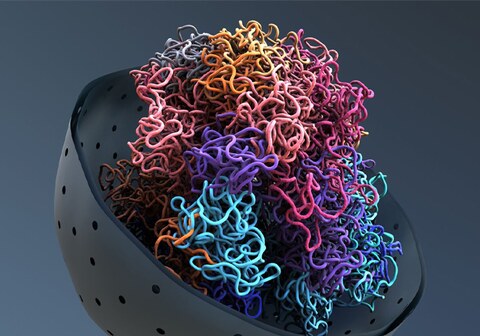
I study how the three-dimensional organization of the genome controls gene expression and how it goes awry in human disease.
Current positionResident, Clinical Pathology · UCSF
TrainingMD/PhD · UCLA–Caltech MSTP
Prashant Bhat

The architecture of the genome

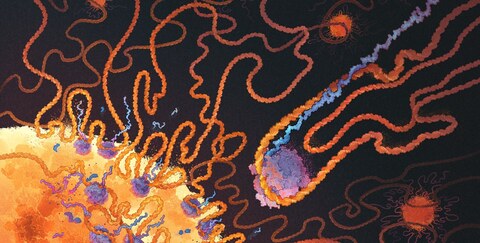
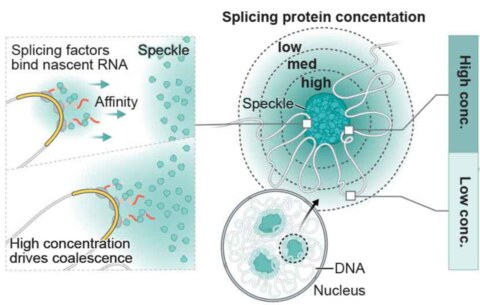
In my PhD work in Dr. Mitchell Guttman's laboratory at Caltech, I developed split-pool technologies to generate high-resolution spatial maps of the human genome and simultaneously profile RNA, DNA, and protein interactions. I applied these technologies to study genome organization around nuclear speckles and discovered that mRNA splicing efficiency is enhanced when genes physically co-associate with speckles.

In the future, I hope to apply these multiplexed detection methods to (i) develop novel molecular diagnostic tools for pathology and (ii) understand how aberrant nuclear architecture on histopathology contributes to disease.

Selected work

2024
Genome organization around nuclear speckles drives mRNA splicing efficiency
Bhat P, Chow A, Emert B, Ettlin O, Quinodoz SA, Strehle M, Takei Y, … Guttman M
Nature · 629:1165–1173 PDF ↗
2025
Mapping and engineering RNA-controlled architecture of the multiphase nucleolus
Quinodoz SA*, Jiang L*, Abu-Alfa A, Comi T, … Bhat P, … Klinge S, Brangwynne CP
Nature
2025
High-resolution spatial multi-omics reveals cell-type-specific nuclear compartments
Takei Y, Yang Y, White J, Goronzy IN, … Bhat P, Guttman M, Cai L
Nature · 641:1037–1047
2022
SPRITE: a genome-wide method to map higher-order 3D spatial interactions using combinatorial split-and-pool barcoding
Quinodoz SA, Bhat P, Chovanec P, Jachowicz JW, Ollikainen N, Detmar E, Soehalim E, Guttman M
Nature Protocols · 17:36–75 PDF ↗
2021
RNA promotes the formation of spatial compartments in the nucleus
Quinodoz SA, Jachowicz JW**, Bhat P**, Ollikainen N, … Plath K, Guttman M
Cell · 184:5775–5790 PDF ↗
2021
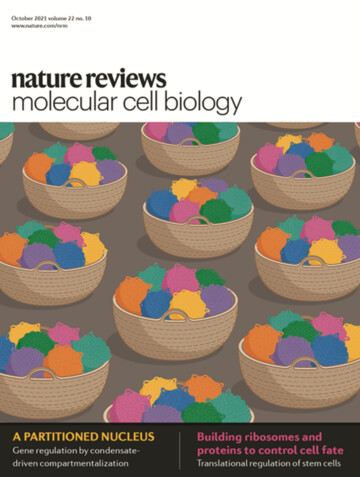
Nuclear compartmentalization as an emerging mechanism for gene expression
Bhat P, Honson D, Guttman M
Nature Reviews MCB · 22:653–670 PDF ↗
2018
Higher-order inter-chromosomal hubs shape 3D genome organization in the nucleus
Quinodoz SA, Ollikainen N, Tabak B, Palla A, … Bhat P, … Guttman M
Cell · 174:744–757 PDF ↗
2014
CasA mediates Cas3-catalyzed target degradation during CRISPR RNA-guided interference
Hochstrasser ML*, Taylor DW*, Bhat P, Guegler CK, Sternberg SH, Nogales E, Doudna JA
PNAS · 111:6618–6623
Full list — Google Scholar

Recognition

2026
Emil Bogen Research Prize
David Geffen School of Medicine at UCLA · May 2026
Presented to a graduating medical student for outstanding research achievement.
2023
Everhart Distinguished Graduate Student Lecture Series
California Institute of Technology · May 2023 · Watch the lecture ↗
"Illuminating the 'Dark Genome' and Membraneless Organelles"
2023
Young TAD Award — 1st Place
Genome Organisation of Australia · 2023
2021
Chen Graduate Innovator Grant Award
California Institute of Technology · 2021
2021
Josephine de Kármán Fellowship
Josephine de Kármán Fellowship Trust · 2021
2020
F30 Pre-Doctoral Fellowship Award
National Cancer Institute · 2020
2014
Outstanding Scholar Award
University of California, Berkeley · May 2014

Background

NowClinical Pathology Resident
UCSFPhysician-Scientist Program
UndergraduateDoudna Lab · UC Berkeley

I am a physician-scientist and clinical pathology resident at UCSF, trained through the UCLA–Caltech Medical Scientist Training Program. My work sits at the intersection of molecular biology, genomics, RNA biology, and biochemistry to study the human genome.

My PhD in Mitchell Guttman's lab at Caltech centered on how the three-dimensional organization of the nucleus regulates gene expression. Using SPRITE (developed in the Guttman lab) I demonstrated that gene proximity to nuclear speckles drives mRNA splicing efficiency, establishing a quantitative principle of gene regulation.

As a physician-scientist, I aim to connect the understanding of nuclear architecture to human disease. I aim to pair diagnostic pathology with a research program grounded in spatial genomics and RNA biology.

I began my research career as an undergraduate in Jennifer Doudna's lab at UC Berkeley during the early days of CRISPR/Cas9, where my senior honors thesis developed biochemical purification methods for E. coli Cas3 and an in vitro DNA degradation assay reconstituting the CRISPR immune response. During my PhD, I held an NIH F30 fellowship and the Josephine De Kármán National Fellowship. My work has been featured in Caltech News, The Scientist, and Prelights.